


The financial press (I reluctantly include television personalities in this description) continually refers to the “bond market” without any distinction. Bonds went up or bonds went down, sometimes accompanied by the explanation that prices move in the opposite direction from yields. Yes and no. All things being equal, which they never are, short maturity bonds fluctuate less than long maturity bonds. Below is a chart depicting the difference between the Bloomberg US Aggregate Bond Index and the Bloomberg US Treasury Bills 1-3 Month Index.
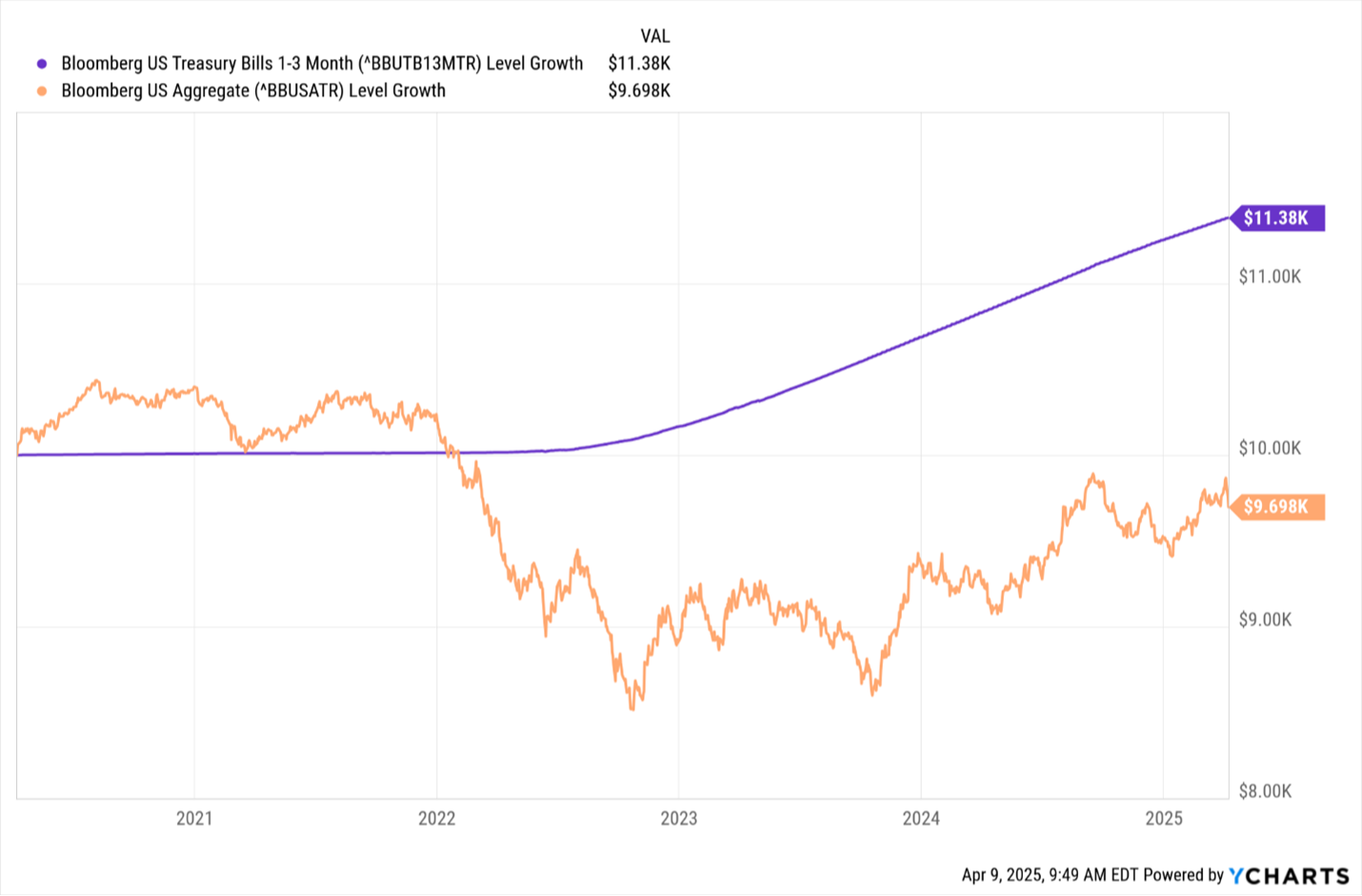
Clearly, the word bonds cannot accurately depict the price performance of both maturities of the same type of obligations.
Most of our portfolios are overweighted to short maturity government obligations, including ETFs that track the 1-3 month and 3–12 month Treasuries. We may be approaching a point where it pays to buy longer term bonds so as to lock in high rates. We are not there yet.
Still, I am hopeful that the opportunity to secure great rates for long periods of time will arrive.
* The Bloomberg 1-3 Month U.S. Treasury Bill Index (^BBUTB13MTR) is designed to measure the performance of public obligations of the U.S. Treasury that have a remaining maturity of greater than or equal to 1 month and less than 3 months. The Index includes all publicly issued zero coupon U.S. Treasury Bills that have a remaining maturity of less than 3 months and at least 1 month, are rated investment-grade, and have $300 million or more of outstanding face value. In addition, the securities must be denominated in U.S. dollars and must be fixed rate and non-convertible. Excluded from the Index are certain special issues, such as flower bonds, targeted investor notes, state and local government series bonds, inflation protected public obligations of the U.S. Treasury, commonly known as “TIPS,” and coupon issues that have been stripped from bonds.
The Bloomberg US Aggregate Bond Index (^BBUSATR) is used as a benchmark for investment grade bonds within the United States. This index is important as a benchmark for someone wanting to track their fixed income asset allocation.