


Each month, except during the recent government shutdown, I puzzle over the components of the Consumer Price Index (CPI). Overall, the 12-month change ended December 31 was 2.7%. Not great, but not terrible. What puzzles me the most is the persistence of extremely high inflation among certain CPI components. For example, energy commodities are down -3% year-over-year, but electricity is up 6.7%. Below is a chart showing electricity inflation over the last ten years. 1

Compare that with the U.S. Natural Gas Liquid Composite Price below 2.

The most common explanation for this is that the data centers necessary to run artificial intelligence are placing an inordinate demand on our power grid. I have little doubt that is true. However, why did electricity prices skyrocket before these data centers came online? I find this explanation particularly unsatisfactory since we now have more utility-scale electricity generation capacity than ever before, as the chart below shows.
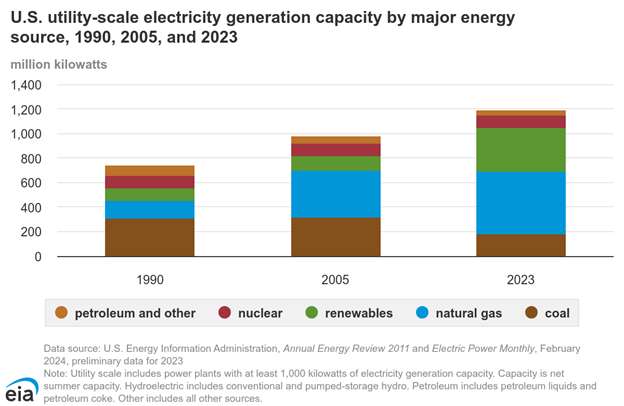
The problem appears to be renewables, which are second only to natural gas as an energy source for electricity. I'm not sure how much usable capacity the natural gas numbers represent since the more windmill capacity we add the more we need to add natural gas power plants. Why? Because windmills and solar are intermittent power sources that require expensive redundancies when using currently available technology. In other words, more windmills equal more natural gas use without a lot more baseload capacity. These are the things that nag at me when I look at the CPI numbers.
We may see the development of low-cost solid-state batteries sometime in the future. These would potentially solve some problems with renewables while also improving the safety and range of electric cars and other devices. Up until now, the theory has been that if there were enough windmills and solar panels, they could be connected together in such a way that the intermittency problem could be solved. Spain attempted to run their country solely on renewables last April. The result was a complete grid failure and a blackout in Spain and Portugal that effected 55 million people.3 Trains stopped, people were stuck in elevators, air conditioners ceased to function. It was a mess.
Other outliers on the inflation front continue to be piped natural gas +10.8%, fuel oil +7.4%, hospital services +6.6%, motor vehicle maintenance and repair +5.4%. A link to the entire CPI report is here https://www.bls.gov/cpi/ 4 Most of these will take time to fix.
From an investment standpoint, I have observed since the 1970s OPEC crisis how windmills capture the imaginations of many investors. The same thing is true of cannabis, another investment black hole that has cost many an investor dearly. Because of Spain, I am finding it difficult not to make Miquel de Cervantes references. I shall resist the impulse, just as most people should avoid making large investments in wind or pot. At least in my opinion.
1.) U.S. Bureau of Labor Statistics, Average Price: Electricity per Kilowatt-Hour in U.S. City Average [APU000072610], retrieved from FRED, Federal Reserve Bank of St. Louis; https://fred.stlouisfed.org/series/APU000072610, January 13, 2026. Accessed on 01.14.2026.
2.) U.S. Energy Information Administration, U.S. Natural Gas Liquid Composite Price [MNGLCP], retrieved from FRED, Federal Reserve Bank of St. Louis; https://fred.stlouisfed.org/series/MNGLCP, January 13, 2026.
3.) Lomborg, B. "The Physics Behind the Spanish Blackout." The Wall Street Journal, Online, June 02, 2024. https://www.wsj.com/opinion/the-physics-behind-the-spanish-blackout-solar-and-wind-power-unstable-grid-8be54b2a. Accessed on 01.14.2026.
4.) U.S. Bureau Of Labor Statistics. https://www.bls.gov/cpi/. Accessed on 01.14.2026.