


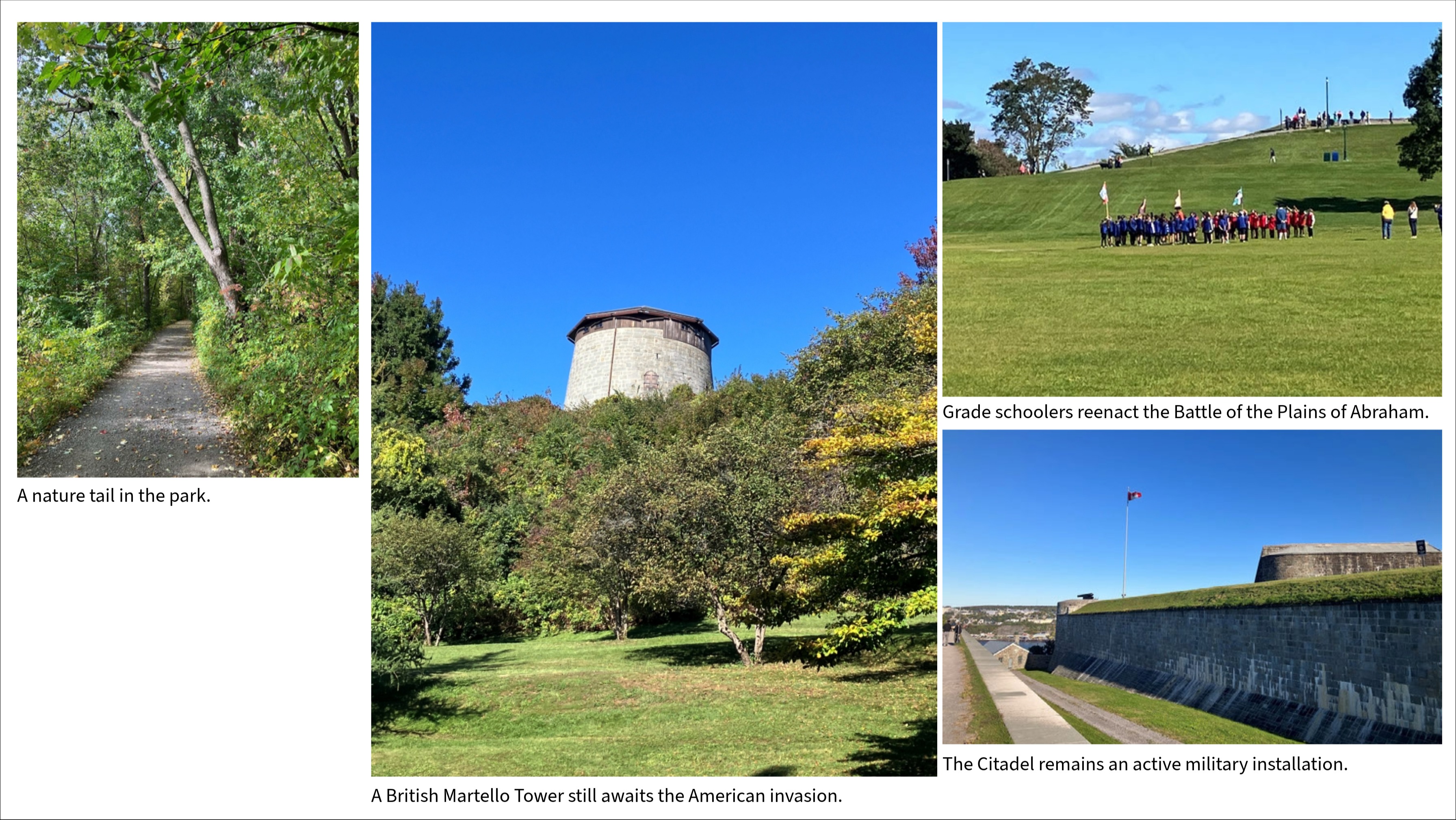
I love parks. Since moving to Vero Beach, I have always lived near Riverside Park so that I can enjoy the exercise trail and be outside among the trees. When I bought my condo in Québec City, I chose it for its easy access to the nature trails that run through a small wood along the St. Lawrence River that is separated from the city by the hills and gardens of the Plains of Abraham. I have fond memories of my daily walks there. For francophone Canadians, the Plains reside in their collective memory as the site of the British conquest of New France.
The Québec motto that we have all seen on license plates, “je me souviens,” means “I remember.” Within this walled city the French military loss is impossible to forget. Cannons are everywhere and the fortified Citadel overlooking the city continues as both an active military installation and as the governor general’s residence. Constructed by the British after the War of 1812 to defend against the United States, it also served as a refuge for the British military during French uprisings. Less obvious than this ancient fortress is how the British victory forever defined the governing principles of modern Canada.2
When the Seven Years’ War concluded with the signing of the Treaty of Paris in 1763, the former French colony became a province, in the Roman sense, of the British Empire. Unlike the American colonies, where self-rule and democratic experimentation evolved over centuries, Britian ruled the new province with the same tools it used in Africa and India. The French academic and political observer André Seigfried wrote that if you “consider the civil servants of [British] India you better understand the masters of Canada.”3
Politically, the American melting pot concept of assimilation could never work when ruling an imperial possession composed of a foreign ethnic, religious, and linguistic population. What is today idealized as the “Canadian mosaic” began as a tool of imperial rule. The “elites” chose “institutional division based on ethnicity and religion. Each of the major groups would be boxed within distinct institutions: churches, schools, colleges, universities, hospitals, aid groups, charitable societies, newspapers, national societies, etc.” The different groups came to include French Catholics, Irish Catholics, Italian Catholics and Jews. The Empire granted some civic authority over marriages, divorces, inheritance, and so forth to leaders of these communities while reserving all other powers to British representatives. This is the opposite of our system of enumerated federal powers with all other powers being reserved to the states and to the people.3
Our Founding Fathers failed to understand that the people of Québec, a population untrained in classical history and unfamiliar with the latest Enlightenment thinking, did not see themselves as aligned with the freedom fighters to their south. Jefferson erroneously believed as late as the beginning of the War of 1812 that “the acquisition of Canada this year, as far as the neighborhood of Québec, will be a mere matter of marching.” So long as the British presence represented a minority that allowed French traditions and customs to continue, it seemed that they had only traded one set of overseas rulers for another. To a francophone Catholic the Americans appeared to be little different from the British.3
Sadly, for the Québécois, another group of defeated people would flood north, a very large group loyal to the King of England, proud of their British citizenship, and understandably resentful of their former countrymen. The coming of the American Tories would change Canada and Canadian relations with the United States forever.
1. Gigi Suhanic, “Canada’s economy could grow by 7% if internal trade barriers removed, says IMF,” Financial Post, Jan. 28, 2026. https://financialpost.com/news/economy/canada-tariffing-itself-interprovincial-trade-barriers-imf
2. “Citadelle de Québec,” Ville de Québec, last modified 2026, https://www.ville.quebec.qc.ca/citoyens/patrimoine/quartiers/vieux_quebec/interet/citadelle_de_quebec.aspx
3. Paul-André Linteau, René Durocher, et Jean-Claude Robert, Histoire du Québec Contemporain (Montréal : Boreal, 1989), 63-69.
4. Stephen Budiansky, Perilous Fight : America’s Intrepid War with Britain on the High Seas, 1812-1815 (New York: Knopf, 2010), x.