


Imagine being born a British citizen in any of the American colonies, perhaps the second or third generation of your family. Maybe you have become a respectable landowner with established ties to England. One day, a wealthy plantation owner pens a screed calling for the dissolution of American bonds with the mother country. You resist and ultimately lose your property and your status while becoming the target of derision and violence. You flee to England’s new possession to the north and begin again. My guess is that you would see yourself as the respectable person and your former countrymen as traitorous Yahoos. Inconveniently, your new refuge is already occupied by Great Britian’s traditional enemies, the French. The outcome that evolved over centuries is a federation designed to accommodate irreconcilable differences.
The arrival of the American Tories in Québec forced the British in 1791 to split the province in two, renaming one Lower Canada and the other Upper Canada. Lower Canada became today’s Nation of Québec while Upper Canada conformed roughly to what we now know as Ontario. That didn’t last long.
After the francophone rebellions of 1837-1838, the British sent John Lambton, 1st Earl of Durham to assess Canadian reform. According to Lord Durham, “I find two nations at war within the same state: I find a fight, not of principles, but of races.” No surprise then that he recommended that it is “the superior race that must during the next epoque dominate over all the continent of North America.” This was evident because of the “superior intelligence” of the British race and because the francophones were “a people without history and without literature.”1
The Unification Act took effect in July 1840. The law banned the usage of French in all public institutions and “shared their public debts, even though the population of Lower Canada, being superior in number, had lower debt.” Despite the Unification Act, the British ruled three separate and independently governed provinces in North America that would not become known as Canada until the British North American Act of 1867, billed by the British as “a pact between two nations.”1
Today, Québec is an officially recognized nation within the Canadian federation. Atop the Second Empire style National Assembly building, which houses the parliament of the Nation of Québec, flies the Québec flag. A Canadian flag is nowhere to be seen. The bronze plaques at the entrance are solely in French. Québec maintains general delegations in Brussels, Dakar, London, Mexico, Munich, New York, Paris, and Tokyo. It also has delegations in Atlanta, Boston, Chicago, Houston, Los Angeles, Miami, Rome, Seattle, Seoul, Singapore, and Washington.2
Québec defends its own interests, as do the other provinces to varying degrees. These interests are cultural and economic, just as they are for countries within the European Union. International trade deals by Ottawa are no more welcome by Québec farmers than Brussels deals are by the farmers of France or the Netherlands. Free trade exists within the EU and Canada only in so far as they share a common currency and freedom of movement. Due to its history, Canada is a decentralized federation accommodating different languages and different cultures. France would not be France without its local food and small villages any more than Québec would be unique without its own farms, villages, and language.
Canada relies on trade with the United States because so little trade occurs within Canada. The Financial Post reports that “65% of Canadian businesses [don’t] have any interprovincial sales.” Internal tariffs average 9% and the International Monetary Fund estimates “it’s as high as 40 per cent in sectors such as health care and education. Lift the barriers, however, and the economy could potentially grow by seven per cent.” The United States has historically served as an essential economic outlet enabling Canada to overcome structural challenges at home. There is no commerce clause in Canada, but there is one in the United States. Access to America is access to all 50 states. The intensity of the current trade conflict with the U.S. is politically tied to two expected secession votes in Canada, one based on the unique interests of Québec and the other representing the energy interests of Alberta.3
A benefit to the United States resulting from Canada’s lack of economic integration is that “roughly 40 percent of Canadians who would rank in the top 1 percent of earners have emigrated south.” Moreover, “these top earners account for three-quarters of the Canada-U.S. GDP per adult gap and up to two-thirds of the labour productivity gap.” Even with recent unprecedented immigration into Canada, our northern neighbor has negative net migration and is losing to the United States many of its most highly educated and creative citizens.4
Prime Minister Carney gave a speech at the Citadel on January 22. In it he repeated the Tory loyalist version of Canadian history. He claimed that the Plains of Abraham are “the place where Canada began to make its founding choice of accommodation over assimilation, of partnership over domination, of building together over pulling apart.” That didn’t go over well at the site of the Conquest, but he is right about one thing. Negotiating a good trade deal will require multiple accommodations.5
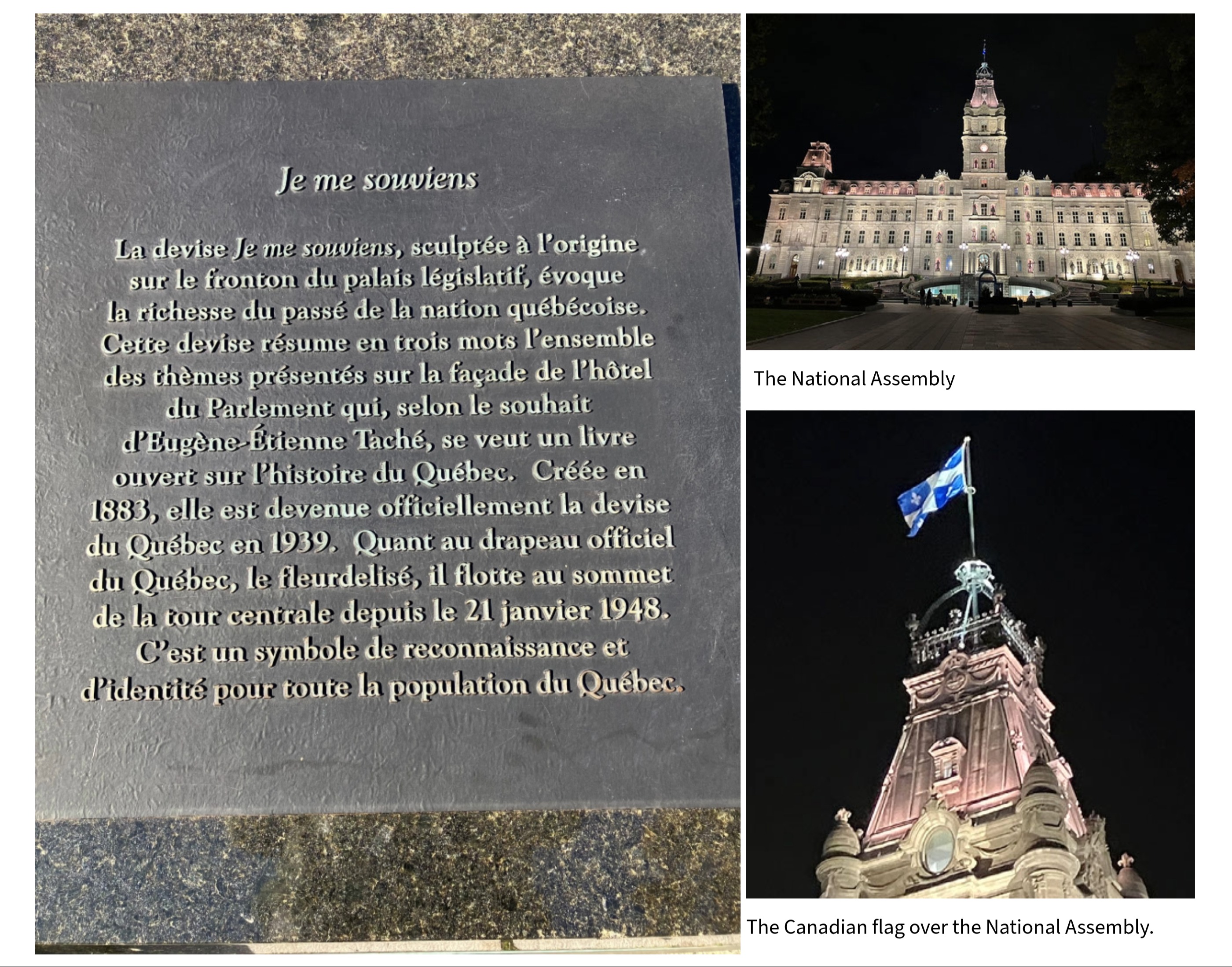
1. Jean-François Cardin and Claude Couture with the Collaboration of Gratien Allaire, Histoire du Canada : Espace et Différences (Québec : Laval University Press, 1996), 47-49.
2. “Québec government offices abroad” Québec.ca, last modified May 27, 2025, https://www.quebec.ca/en/gouvernement/ministeres-organismes/relations-internationales/quebec-government-offices-abroad.
3. Gigi Suhanic, “Canada’s economy could grow by 7% if internal trade barriers removed, says IMF,” Financial Post, Jan. 28, 2026. https://financialpost.com/news/economy/canada-tariffing-itself-interprovincial-trade-barriers-imf.
4. Charles Lamm, “Canadians are leaving the country at record levels. Can anyone solve this pressing problem?” The Hub, April 3, 2026, https://thehub.ca/2026/04/03/can-anyone-solve-canadas-brain-drain-problem/.
5. “Building Canada together: Prime Minister Carney delivers remarks at the Citadelle of Québec” last modified January 22, 2026, https://www.pm.gc.ca/en/news/speeches/2026/01/22/building-canada-together-prime-minister-carney-delivers-remarks-citadelle.